

Common causes and solutions for centrifugal pump impeller failures
May 27, 2026
Leave a message
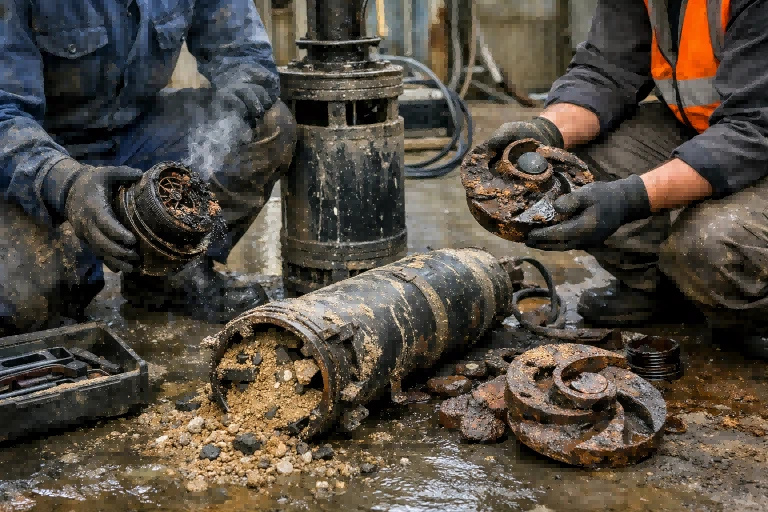
Centrifugal pumps, as core equipment for fluid transportation, are widely used in petrochemical, water conservancy and municipal, power, and pharmaceutical industries. The impeller is considered the "heart" of a centrifugal pump, and its operating status directly affects the pump's efficiency, performance, and overall reliability. Based on engineering practice, this paper systematically reviews several typical failure modes of centrifugal pump impellers, including cavitation, wear, corrosion, foreign object blockage, and fatigue fracture, and analyzes them with practical case studies. Finally, corresponding prevention and countermeasures are proposed to provide useful reference for engineering technicians.
-
Common faults of centrifugal pump impeller
Cavitation Damage
Mechanism: When the local pressure at the pump inlet is lower than the saturated vapor pressure of the liquid at that temperature, the liquid vaporizes to form bubbles. These bubbles, carried by the fluid to the high-pressure zone, collapse rapidly, generating an instantaneous, extremely strong local impact force (up to hundreds of MPa). This continuous microscopic impact causes fatigue spalling of the impeller material surface, ultimately forming honeycomb-like pits and pores.
Characteristics: In the early stages of cavitation, pump performance deteriorates (flow rate and head decreases), accompanied by noticeable popping sounds and vibrations. The area near the front cover plate at the impeller blade inlet edge is the primary site of cavitation damage.
Abrasion and Corrosion
Abrasion: When the pumping medium contains solid particles (such as silt, slurry, catalyst powder, etc.), these particles continuously cut and scour the impeller surface, leading to continuous material loss. The degree of abrasion depends on the hardness, concentration, geometry of the particles, and the fluid velocity.
Corrosion: This refers to the electrochemical or chemical reaction between the medium and the impeller material, leading to material deterioration and dissolution. When abrasion and corrosion act together, they produce a synergistic effect, significantly accelerating the material failure process; the combined rate of damage is far higher than the sum of their individual effects.
Characteristics:
Abrasion: The impeller surface tends to be smooth, the flow channel wall thickness decreases, and the blade tips gradually become pointed.
Corrosion: Manifests as uniform thinning overall or localized pitting and ulcer-like pits.
Foreign Object Blockage and Entanglement
Mechanism: When the pre-pump filter fails, or the pumped medium itself contains fibers or long, thin debris, these foreign objects can enter the pump chamber and become stuck in the impeller inlet or the flow channels between the blades, causing blockage.
Characteristics: Significantly increased pump vibration, a sharp drop in flow rate, or even flow interruption. Abnormally high motor current, which in severe cases may lead to motor overload tripping or pump shaft breakage.
Fatigue Fracture
Mechanism: During operation, the impeller is subjected to rotational centrifugal force and alternating stress caused by an uneven flow field. At stress concentration points (such as the radius of curvature at the blade root connection to the shroud, or casting defects), long-term alternating loads can induce microcracks. These cracks gradually propagate, eventually leading to blade fracture or the complete rupture of the impeller.
Characteristics: Typically accompanied by a slow but continuous increase in vibration values. The fracture surface often exhibits typical conchoidal or beach-like fatigue striations, which can serve as an important criterion for fracture diagnosis.
-
Solutions and Preventive Measures
Cavitation Prevention
- Optimize System Design: Ensure NPSHA is significantly greater than NPSHr, typically with a safety margin of 0.5-1.0 meters.
- Operation and Maintenance: Avoid prolonged operation of the pump under excessively low flow conditions. Regularly clean the inlet filter and maintain unobstructed suction lines to prevent cavitation caused by blockage.
- Materials and Repair: Select materials with superior cavitation resistance, such as stainless steel, duplex steel, or Stellite alloy weld overlay in cavitation-prone areas of the impeller. For impellers already damaged by cavitation, advanced processes such as laser cladding can be used for repair to restore performance and extend service life.
Combating Abrasion and Corrosion
- Material Selection: Select high-performance materials that match the abrasive and corrosive characteristics of the pumped medium. For example, high-chromium cast iron is suitable for highly abrasive conditions, while Hastelloy and titanium are used in highly corrosive environments.
- Surface Treatment: Harden or protect the impeller surface. Common methods include spraying tungsten carbide coatings, ceramic coatings, or nitriding to improve surface hardness and corrosion resistance.
- Design Optimization: Reduce the fluid scouring effect by lowering the impeller outlet velocity; prioritize closed impeller structures to improve hydraulic stability and mechanical strength; simultaneously, appropriately increase the thickness of blades and cover plates during the design phase, allowing sufficient corrosion allowance.
Preventing Clogging and Entanglement
- Enhanced Pre-treatment: Install reliable filtration devices (such as basket filters, rotary filters, etc.) before the pump and establish a regular cleaning system to reduce the entry of foreign matter at the source.
- Optimized Structural Design: For applications involving the conveying of media containing fibrous impurities, prioritize impeller structures with anti-entanglement designs, such as channel impellers and vortex impellers.
Prevent fatigue fracture
- Ensuring Manufacturing Quality: Strictly control the casting and machining processes of the impeller, and employ non-destructive testing techniques (such as X-ray and ultrasonic testing) to ensure the absence of internal defects such as sand holes, porosity, and cracks.
- Reducing Vibration Sources: The impeller must undergo precise dynamic balancing. Simultaneously, ensure the alignment accuracy of the pump and motor to eliminate additional periodic stresses caused by misalignment.
- Regular Inspection: Utilize condition monitoring technologies (such as vibration analysis and acoustic emission technology) to monitor the impeller's operating status in real time, enabling timely detection and early warning of potential fatigue cracks.
Impeller failure is one of the more common faults in centrifugal pump operation, mainly caused by blade damage, deformation, loose structure, and wear. Different repair methods can be used to address different faults. During maintenance, safety and operating procedures must be followed to ensure the effectiveness and reliability of the repair.