

Axial flow pumps and mixed flow pumps: characteristics, applications and selection comparison
Apr 14, 2026
Leave a message
In industrial production, agricultural irrigation, and urban water supply and drainage, water pumps are crucial equipment for transporting liquids, making their selection paramount. Mixed-flow pumps and axial-flow pumps, as two common types of pumps, each have unique working principles and performance characteristics. Today, we will compare the performance of mixed-flow pumps and axial-flow pumps in detail and provide a practical selection guide to help you easily choose the most suitable pump!
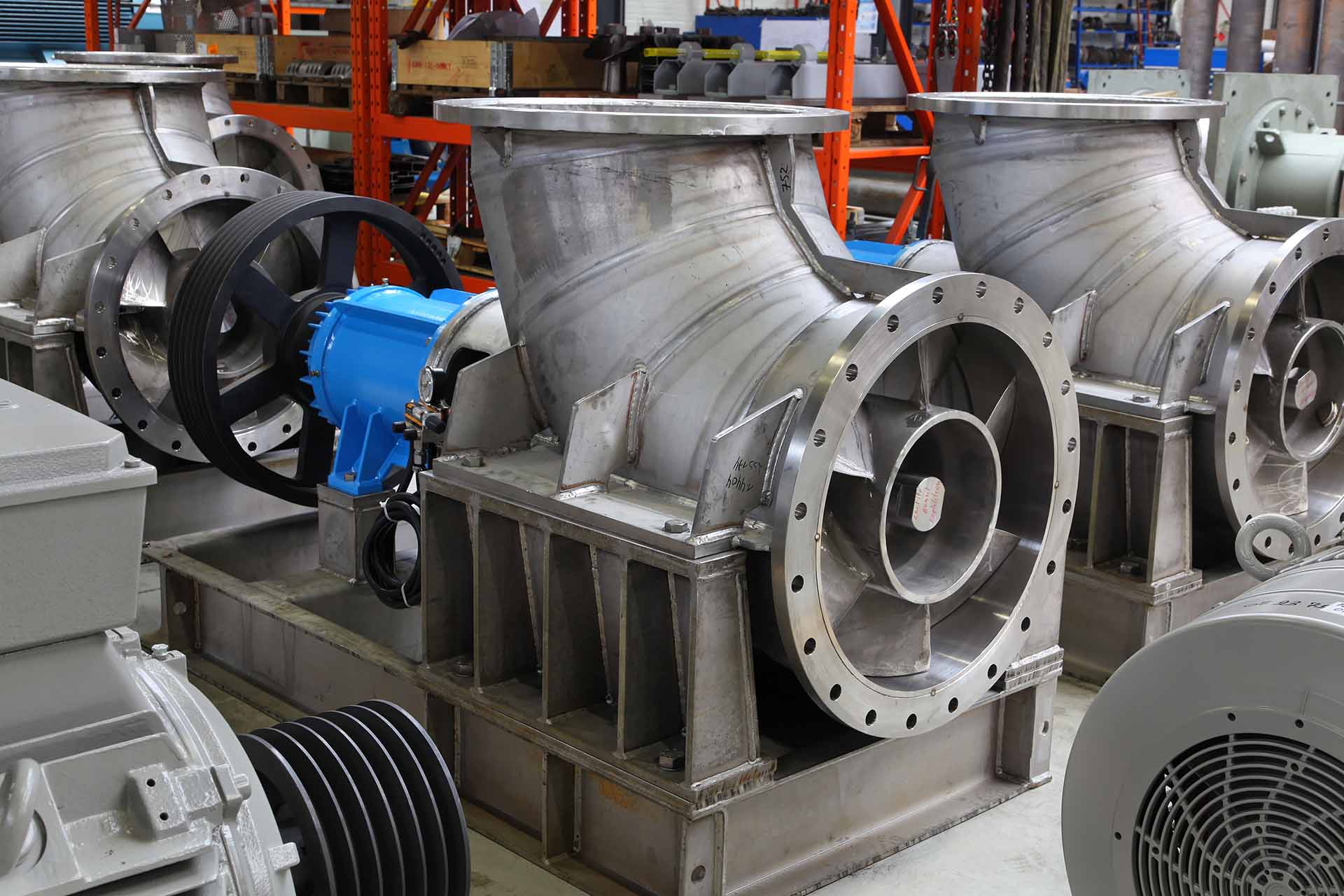
-
What is an axial flow pump?
An axial flow pump uses an impeller to propel fluid parallel to the pump axis, similar in principle to a ship's propeller. As a type of centrifugal pump, axial flow pumps are sometimes called axial-flow centrifugal pumps. Their impellers use curved blades, causing the fluid to accelerate linearly along the axial direction. Because the fluid is directly pushed backward, axial flow pumps can generate extremely high flow rates, but their head is relatively limited. For example, a large axial flow pump can deliver tens of thousands of cubic meters per hour of water at a head of only a few meters, and its efficiency is optimal at low head conditions.
Axial flow pumps use a simple impeller structure similar to a propeller. Compared to other types of pumps, axial flow pumps have straight internal flow channels and fewer flow pattern changes, making them easier to manufacture and maintain, and they also have high efficiency near their design operating point. However, it is important to note that if the operating head exceeds the rated range, the axial flow pump may experience a sudden drop in efficiency or even stall.
-
Flow Characteristics of Axial Flow Pumps
The core characteristic of an axial flow pump is that the fluid passes through the impeller axially, with both the inlet and outlet directions parallel to the pump shaft, forming a straight-through flow channel. Therefore, axial flow pumps are typical high-flow-rate, low-head devices. They can efficiently transport extremely large flow rates (typically thousands of m³/h), but their head increase is limited (usually only a few meters). If the actual head exceeds the design range, the flow rate of the axial flow pump will drop sharply.
Due to the straight flow channel and smooth flow, the internal velocity of an axial flow pump is extremely high, making it very suitable for large-scale liquid transportation. The flow state inside the impeller tends to be a stable laminar flow with low internal losses, thus exhibiting high peak efficiency within its design head range. However, as the head increases, the efficiency decreases rapidly; when the head exceeds several meters, the axial flow pump may experience extremely low efficiency or even stall.
-
Applications and Uses of Axial Flow Pumps
Axial flow pumps are suitable for applications requiring extremely high flow rates and low head. Common applications include:
Agricultural Irrigation: Drawing water from rivers or reservoirs and transporting it to farmland via open channels, achieving long-distance water delivery at low head.
- Drainage and Flood Control: Used for foundation pit drainage, tunnel dewatering, and basement or river drainage, rapidly removing accumulated water with high flow rates.
- Large-Scale Water Transfer: Achieving high-flow-rate water transfer in open channel or pipeline projects with minimal head variations.
- Pumped Storage: Used in pumped storage power stations for water body regulation between upper and lower reservoirs when high-flow-rate water transfer is required.
- Wastewater Treatment: Transporting wastewater or effluent in the low-head section (such as collection wells) of wastewater treatment plants.
- Aquaculture: Used for water circulation in large fishponds or shrimp ponds.
In short, axial flow pumps are ideal for any application requiring the delivery of large flow rates of relatively clean water at extremely low head. However, axial flow pumps are less suitable for systems requiring higher head.
-
What is a mixed-flow pump?
A mixed-flow pump combines the characteristics of axial-flow and radial-flow pumps. It employs a diagonal (or oblique) impeller, causing the fluid to flow partly axially and partly radially. In actual operation, the liquid enters the impeller and flows out at an angle to the pump shaft, is collected by the pump casing (usually a volute or guide vanes), and then guided to the outlet. Thus, a mixed-flow pump combines the high flow rate of an axial-flow pump with the relatively high head of a radial-flow pump.
The performance of a mixed-flow pump lies between that of a pure radial-flow pump and a pure axial-flow pump. As KSB states, a mixed-flow pump "covers the transition region between radial and axial-flow pumps." In other words, a mixed-flow pump is essentially a type of centrifugal pump (often called a mixed-flow centrifugal pump), whose impeller imparts both radial and axial momentum to the fluid. A typical mixed-flow impeller (also called an oblique-flow impeller or a helical impeller) uses curved blades to give the fluid a certain radial velocity. As the impeller rotates, it generates both backward and outward thrust, achieving a good balance between flow rate and head.
-
Mixed-flow pump flow characteristics
Mixed-flow pumps are designed for medium-head, medium-flow applications. The fluid inside simultaneously achieves radial and axial velocities, resulting in a performance compromise between axial-flow and radial-flow pumps: it can deliver large flow rates (thousands of m³/h) like an axial-flow pump, while also withstanding higher pressures (tens of meters of head) like a radial-flow pump.
Head: Mixed-flow pumps typically have a single-stage head of 10 to 50 m, far exceeding the few meters of head range of axial-flow pumps, making them suitable for pumping water to elevated tanks or overcoming moderate head differences.
Flow rate: Slightly lower than axial-flow pumps of the same size, but still maintaining a high flow rate level (thousands of m³/h), generally falling between radial-flow and axial-flow pumps.
Efficiency: Mixed-flow pumps typically maintain high efficiency within their operating range. Through optimized flow channels using guide vanes, diffusers, and other structural features, the conversion of kinetic energy to pressure energy is more efficient – mixed-flow pumps are generally highly efficient in medium-head applications.
Stability: The performance curve of a mixed-flow pump is generally flatter and more stable than that of an axial-flow pump. When the head changes, the flow rate of a mixed-flow pump changes relatively smoothly, while the flow rate of an axial-flow pump decreases sharply as the head increases.
Structurally, mixed-flow pumps often use a volute or guide vanes to collect obliquely discharged water. Many models employ a semi-open impeller to handle conditions containing abrasive media (offering advantages in solid particle passage compared to a fully open impeller). Mixed-flow pumps can be designed as single-stage structures to meet medium-head requirements or as multi-stage structures to achieve higher heads.
-
Applications and Uses of Mixed-Flow Pumps
Mixed-flow pumps are suitable for applications requiring high flow rates and medium head. Typical applications include:
- Industrial Cooling: Circulating cooling water in power plants or chemical plants, where certain system resistance must be overcome.
- Process Industries: Used in paper mills, oil refineries, or manufacturing plants for transporting process water or other fluids under medium head conditions.
- Agricultural Irrigation: Suitable for irrigating sloping terrain or scenarios requiring pumping water to a certain height, such as lifting water from rivers to elevated channels.
- Drainage and Sewage Discharge: Used to lift sewage to treatment plants or discharge rainwater under high flow rate, low to medium head requirements. Many sewage pumping stations use mixed-flow pumps (vertical turbine pumps) to lift sewage.
- Marine and Offshore Engineering: Used for ballast, cooling, or fire-fighting water systems on ships or platforms, requiring a compact pump design and medium head capacity.
- Rainwater Management: Used to lift runoff to sewers or storage tanks, overcoming the effects of gravity.
Mixed-flow pumps can be considered the ideal choice for the "middle ground" – when axial-flow pumps have insufficient head, and high-head radial-flow pumps seem like an overkill, mixed-flow pumps are often the first choice.
-
Core Differences Between Axial Flow Pumps and Mixed Flow Pumps
1. Flow Direction and Discharge Method
- Axial Flow Pump: Fluid is discharged in a straight line along the pump shaft. Both the inlet and outlet directions are collinear with the pump shaft, and the outlet is usually centered with the inlet.
- Mixed Flow Pump: Fluid is discharged at a certain angle. The impeller gives the fluid both backward and outward velocities, and the flow channel is conical. Therefore, the outlet is usually offset, or a volute/spiral flow channel is required to collect the oblique flow.
This means that the piping layout differs: Axial flow pumps often use straight pipes or linear piping; while mixed flow pumps usually have an oblique outlet or a volute structure. In vertical installations, axial flow pumps can discharge water vertically upwards or horizontally, while vertical mixed flow pumps deliver water upwards at a certain angle.
2. Head and Flow Rate Comparison
- Axial Flow Pump: Delivers extremely high flow rates at a low head. It can provide very large flow rates (e.g., 10,000 to 40,000 m³/h), but the head is only a few meters. If the system requires a medium head (e.g., 10 to 15 m), axial flow pumps may experience stalling or a sudden drop in flow rate.
- Mixed-flow pumps: These deliver large flow rates at medium heads. They can maintain a high flow rate while achieving a head of tens of meters. Selection experience: If the required head is <5 to 10 m and the flow rate is extremely high, choose an axial flow pump; if the required head is high (10 to 50 m) and a high flow rate is still needed, choose a mixed-flow pump. Axial flow pumps have a steep performance curve – the flow rate decreases rapidly as the head increases; mixed-flow pumps have a relatively flat curve and are more adaptable.
For example, an axial flow pump might deliver 20,000 m³/h at a 5 m head, but the flow rate approaches zero when the head increases to 15 to 20 m; while a comparable mixed-flow pump might still deliver 15,000 m³/h at a 20 m head. Therefore, mixed-flow pumps cover the operating range where axial flow pumps are less effective.
3. Impeller Design and Structure
- Axial Flow Impeller: Resembling a large propeller or fan in appearance, it uses wide, flat blades arranged along the pump shaft. Typically, it has fewer blades and an open structure (without a cover plate), directly pushing the water flow backward. Most axial flow impellers are without a cover plate, while a few are equipped with a simple cover plate or side ring.
- Mixed Flow Impeller: Employs multiple curved and angled blades, which are twisted to allow the fluid to be discharged simultaneously laterally and backward (i.e., obliquely). Mixed flow impellers usually have a partial cover plate or ring to accommodate the oblique water flow; their shape is sometimes referred to as helical or oblique flow.
Structurally, mixed-flow pumps typically feature a more robust casing (volute or guide vanes) to guide the obliquely discharged water, and often incorporate guide vanes or diffusers to efficiently convert kinetic energy into pressure energy. Axial-flow pumps, on the other hand, employ a simpler, straight-through casing.
4. Efficiency and Performance
- Axial-flow pumps: Extremely efficient under design conditions (high flow rate, low head). Due to the straight flow path, energy loss is minimal under these conditions. However, their high-efficiency range is relatively narrow; if forced to operate at higher heads, efficiency drops sharply.
- Mixed-flow pumps: Maintain good efficiency over a wider flow/head range. Mixed-flow pumps typically employ flow-optimized designs (such as shrouds and guide vanes) to maintain high efficiency in the medium head range. In actual operation, a mixed-flow pump operating at a medium head may consume less energy than an axial-flow pump performing a similar task at a slightly higher head.
In short, axial flow pumps excel in purely high flow rates (lowest head); while mixed flow pumps are superior in overall performance across both flow rate and head. As KSB states, mixed flow pumps have relatively flat flow curves in the medium head, medium flow range, while axial flow pumps have steep curves in the low head, maximum flow range. Therefore, when only flow rate is a concern, axial flow pumps offer significant energy savings; when a certain head is required, mixed flow pumps utilize energy more efficiently.
5. Performance Comparison: Mixed Flow Pumps vs. Axial Flow Pumps
In practical selection, the key is determining the operating point (flow rate Q and head H):
- Axial Flow Pump Performance: Achieves excellent flow rates at extremely low heads. For example, an axial flow pump can achieve a flow rate of 10,000 m³/h at a head of 5 m, but the flow rate rapidly decreases beyond 5 to 10 m, resulting in a very steep performance curve.
- Mixed Flow Pump Performance: Achieves high flow rates at medium heads. A mixed-flow pump can achieve a flow rate of 8,000 to 15,000 m³/h at a head of 15 to 25 m, with a significant performance decline only near a head of 40 to 50 m, exhibiting a relatively flat performance curve.
- In short: axial-flow pumps are more efficient at low heads and high flow rates; mixed-flow pumps perform better when a certain head (tens of meters) is required.
6. Structural Comparison: Mixed-Flow Pumps vs. Axial-Flow Pumps
- The differences between the two can be seen from their actual pump structures:
- Axial-flow pumps: Typically use large-diameter, open or semi-open impellers. Many vertical axial-flow pumps use submerged columns and simple propeller impellers, with a simple casing structure and fewer internal components.
- Mixed-flow pumps: More compact in structure, with a larger number of impeller blades arranged at an angle. The casing usually includes a volute or guide vanes.
In terms of maintenance, axial flow pumps have a simple internal structure and fewer parts, but the open impeller may become clogged due to debris entanglement; mixed flow pumps have more parts (such as guide vanes and multi-stage structures), but they are usually equipped with wear-resistant rings or bushings, which have a certain tolerance to solid particles in the fluid.
-
How to Choose the Right Pump: Axial Flow Pump or Mixed Flow Pump?
Please follow these steps for selection:
- Define the operating conditions: Determine the required flow rate (Q) and head (H) at the operating point.
- Compare performance curves: If the operating point requires a low head (e.g., <5 to 10 m) and a very high flow rate, an axial flow pump is usually the ideal choice; if a higher head (e.g., 10 to 50 m) is required and the flow rate is still relatively high, a mixed flow pump is more suitable.
- Consider installation conditions: Axial flow pumps typically require straight pipe sections and may be installed vertically; mixed flow pumps require attention to suction conditions.
- Evaluate media characteristics: If the fluid contains some solid particles, a mixed flow pump (especially with a semi-open impeller) is more advantageous.
- Balance efficiency and cost: Compare the expected energy consumption with the purchase cost. Axial flow pumps generally have a lower cost per unit flow rate, but if a higher head is required, a mixed flow pump may be more energy-efficient.
For example, if a pump needs to deliver 12,000 m³/h at a head of 5 m, an axial flow pump is the most efficient choice; if a pump needs to deliver 12,000 m³/h at a head of 20 m, a mixed flow pump is better; if the head exceeds approximately 50 to 60 m, a radial flow pump or a multistage pump should be considered.
Understanding the selection principles for axial flow pumps and mixed flow pumps hinges on matching the flow rate and head requirements of the actual operating conditions. Axial flow pumps can deliver extremely high flow rates at low heads; mixed flow pumps, on the other hand, achieve high flow rates at higher heads. By comparing flow direction, performance curves, and impeller structure, you can select the most suitable pump for your specific application.