

What is an axial flow pump?
Feb 27, 2025
Leave a message
Axial flow pump is a kind of vane pump. It uses a rotating impeller with blades to push the fluid to move coaxially with the pump shaft. It is suitable for large flow occasions such as irrigation and drainage. It transmits kinetic energy through the propeller and has high energy efficiency. This article will introduce you to three aspects: structure, use, and working principle. If you are interested, please continue reading!
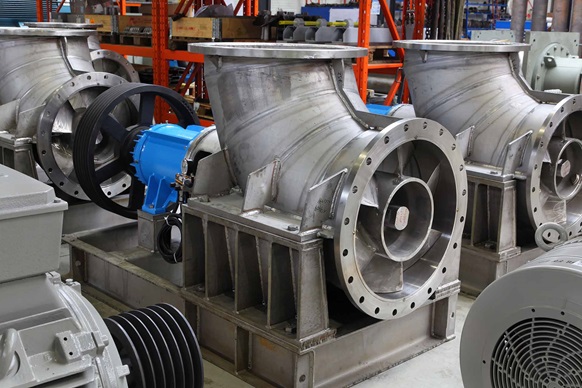
- What is an axial flow pump?
An axial flow pump is a vane pump (dynamic pump) whose blade units are a series of airfoils that form a cylindrical cascade around the hub. Since the traces of the fluid particles flowing through the impeller are theoretically located on a cylindrical surface concentric with the rotating shaft, and the outflow is considered to be along the axial direction after the guide vane derotation, this type of pump is called an axial flow pump.
- Axial flow pump classification
Vertical axial flow pump: the pump shaft is perpendicular to the horizontal plane.
Horizontal axial flow pump: the pump shaft is parallel to the horizontal plane.
Fixed blade axial flow pump: the impeller blades are cast as one piece with the hub.
Semi-adjustable blade axial flow pump: the blades are mounted on the hub through nuts, and the installation angle of the blades on the hub can be adjusted after shutdown.
Adjustable axial flow pump: the angle of the rotor blades can be adjusted to achieve flow and head adjustment.
Diagonal flow axial flow pump: the impeller inclination angle is greater than 0 degrees and less than 90 degrees, which can increase the head while ensuring the flow.
- Structure
The main components of an axial flow pump include an impeller, guide vanes, and a pump shaft.
Impeller: The impeller is the core component of an axial flow pump, consisting of blades, a hub, and a moving blade adjustment mechanism. Open or semi-open design, the blades are often designed as airfoil-shaped, the number is generally 4 to 6, and the angle is adjustable (used to adjust the flow).
Guide vanes: The guide vanes are located on the outlet side of the impeller, converting the rotational motion of the water flowing out of the impeller into axial motion, and at the same time converting part of the kinetic energy into pressure energy. Eliminate fluid rotation and improve efficiency.
Pump shaft and bearings: Long shaft design (common in vertical pumps), usually made of high-quality carbon steel, chrome-plated on the surface to reduce mass and facilitate installation of the adjustment mechanism.
- How it works
The working principle of an axial flow pump is to transport liquids by the thrust generated by the rotating impeller blades. When the pump shaft is driven to rotate by the motor, there is a certain helix angle between the blades and the axis of the pump shaft, which generates thrust on the liquid, pushing the liquid out along the pump shaft and discharging it. This process is similar to the operating principle of an electric fan: the air in front of the fan blades is pushed forward, thereby generating airflow. When the liquid is pushed out, a local vacuum area is formed at the original position, and under the action of atmospheric pressure, the external liquid will be sucked into the impeller through the inlet pipe. As long as the impeller continues to rotate, the pump can continue to inhale and discharge liquid.
- Application Areas
Axial flow pumps are mainly used in low-lift, high-flow applications, such as irrigation, drainage, dock drainage, water level regulation of canal locks, or as large circulating water pumps in power plants. Axial flow pumps with higher lift can be used for water jet propulsion of shallow-water vessels. In addition, axial flow pumps are also widely used in urban water supply systems, urban flood control and drainage, industrial and agricultural water transportation, urban water supply, mild sewage discharge, and water diversion projects.