

What is a water pump performance curve? How to select a suitable pump based on its performance curve?
Nov 04, 2025
Leave a message
When selecting an industrial pump, being able to read the pump's characteristic curve is crucial. The pump's characteristic curve tells you whether it can effectively achieve the required flow rate at a specific pressure, thus indicating whether it is suitable for your application. In this article, we will break down the components of a pump curve and show you how to use it to make a more informed pump selection.

What is a pump curve?
Pump curves are generated by testing pumps in a laboratory and plotting the data on a graph. Typically, the horizontal axis of a pump curve represents flow rate (usually in l/min or m³/h), and the vertical axis represents head (usually in meters). Flow rate and head are two main parameters defining pump performance. Flow rate is the amount of fluid a pump can deliver per unit time. Head is the height to which the pump can lift the fluid. Pump head is directly proportional to the impeller's rotational speed and diameter.
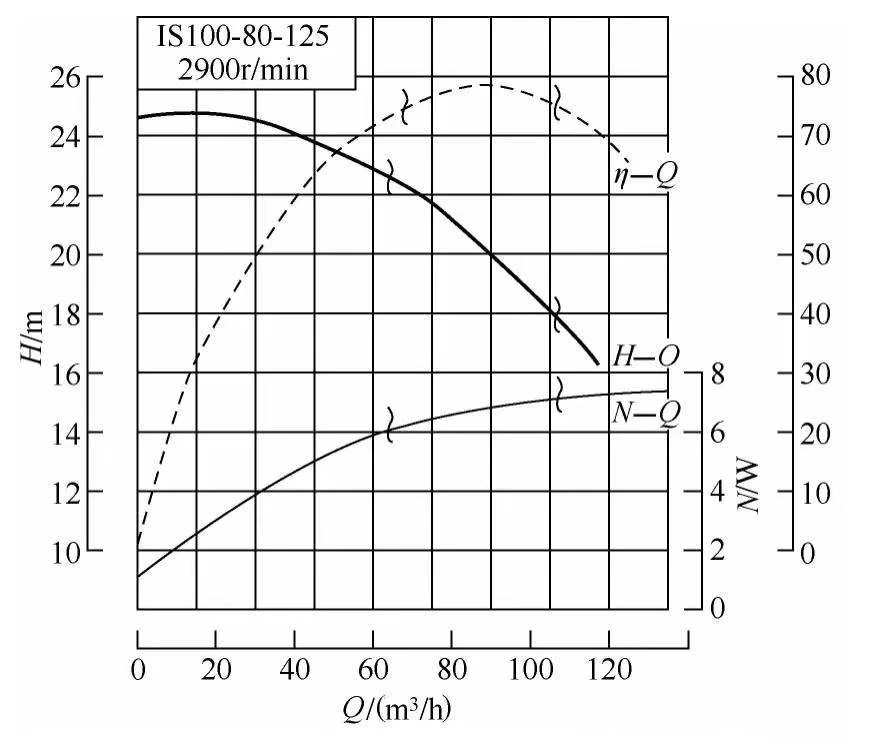
Typical centrifugal pump characteristic curve
A typical pump profile usually consists of the following parts:
Head-Flow Rate Curve (H-Q Curve)
The head-flow rate curve (H-Q curve) shows the relationship between the pump's head and flow rate at a constant speed. The H-Q curve is typically plotted with head on the y-axis and flow rate on the x-axis. This curve shows that as the flow rate increases, the head decreases due to fluid friction and turbulence.
Efficiency Curve (n-Q Curve)
The efficiency curve (n-Q curve) shows the relationship between the pump's efficiency and flow rate at a constant speed. The efficiency curve is typically plotted with efficiency on the y-axis and flow rate on the x-axis. The curve shows that efficiency initially increases with increasing flow rate, but decreases after a certain flow rate. The pump operates most economically at the flow rate and head corresponding to its highest efficiency; these are the optimal operating parameters.
Shaft Power Curve (N-Q Curve)
The shaft power of a centrifugal pump increases with increasing flow rate, reaching its minimum at zero flow rate. Therefore, when starting a centrifugal pump, the pump's outlet valve should be closed to reduce the motor's starting current and protect the motor.
In addition, some pumps also have:
Net Positive Suction Head (NPSHr-Q) curves
The NPSHr curve shows that cavitation gradually increases with flow rate. However, note that this is not the case for some pumps.
How to select a suitable pump based on the pump's performance curve?
Step 1: Define System Requirements
- Flow Rate (Q), in cubic meters per hour (m³/h) or gallons per minute (GPM).
- Total Head (H), in meters or feet.
- NPSHa (Net Positive Suction Head Available).
- Fluid Type, Temperature, Viscosity
Step 2: Overlay Requirements on Pump Profiles
- Find the intersection of the flow rate and head profiles.
- Ensure this point is close to the Best Efficiency Point (BEP).
- Avoid selecting a pump operating at the extreme left (overpressure) or extreme right (low pressure, high flow rate).
Step 3: Check Efficiency and Power
- Select a pump that operates within 80% to 100% of its BEP.
- Confirm that the motor power is sufficient to meet the operating point requirements.
- Consider margins for safety, wear, or system expansion.
Step 4: Review NPSHr
- Compare the pump's NPSHr profile with the system's NPSHa.
- Ensure a safe distance of at least 0.5-1.0 meters.
System Selection
For closed systems equipped with control valves, it is recommended to choose pumps with a flatter pump head curve to reduce the impact of load changes on the system head. For open systems, due to the presence of an additional unbalanced head, pumps with steeper pump head curves are typically selected to ensure a sufficiently high head at constant flow rates.
Choosing the right pump performance curve is one of the most important factors in pump selection. It's necessary to understand the meaning of the pump performance curve, select an appropriate operating point, pay attention to the pump's efficiency and reliability, and comprehensively consider other factors. Only in this way can you select a pump that meets your specific needs, thereby ensuring the normal operation of the equipment.