

The core factors affecting centrifugal pump efficiency and the technical approaches to improve efficiency.
May 15, 2026
Leave a message
Pump efficiency is a frequently discussed topic in the industry, yet it's also one of the technical indicators with the greatest differences in understanding. Different engineers often emphasize different aspects affecting performance, which reflects that pump efficiency is not determined by a single parameter. Instead, overall system efficiency is the result of multiple loss mechanisms working together, each following its own independent physical mechanism and requiring differentiated optimization and management strategies.
This article outlines the core elements determining centrifugal pump efficiency, explains why poor design can lead to significant energy loss, and outlines feasible optimization measures for equipment manufacturers and operators to improve pump unit operating performance and reduce total lifecycle energy consumption.

-
Components of centrifugal pump efficiency
The overall efficiency of a centrifugal pump is obtained by multiplying the efficiencies of several components. Among them, impeller efficiency has the greatest impact on the overall efficiency, directly reflecting the impeller's ability to convert shaft power into hydraulic energy. However, impeller performance alone cannot determine the overall efficiency of the pump; three other types of additional losses further reduce the final output hydraulic energy:
- Leakage Loss: Internal backflow of fluid through the sealing ring and balancing device reduces the effective volumetric flow rate delivered to the outlet. This type of loss is proportional to the clearance size and the pressure difference across the impeller.
- Friction Loss: Energy dissipation occurs as the fluid flows within the volute or guide vane channels. The casing structure, surface finish, and fluid velocity all affect this.
- Mechanical Loss: Bearings, seals, and shaft-driven auxiliary devices consume power that cannot be transferred to the fluid. Mechanical losses are typically small in large pumps, but significantly higher in small pump sets.
-
Two core elements of pump efficiency
Specific Speed
Specific speed (ns) is a dimensionless index calculated based on the pump's optimal efficiency point (BEP) using speed, head, and flow rate.
It is arguably the single most important parameter in pump hydraulic design, determining the basic hydraulic configuration of the impeller: from the radial blade structure with narrow flow channels at low specific speeds to the fully open axial flow structure at high specific speeds, all are defined by specific speed.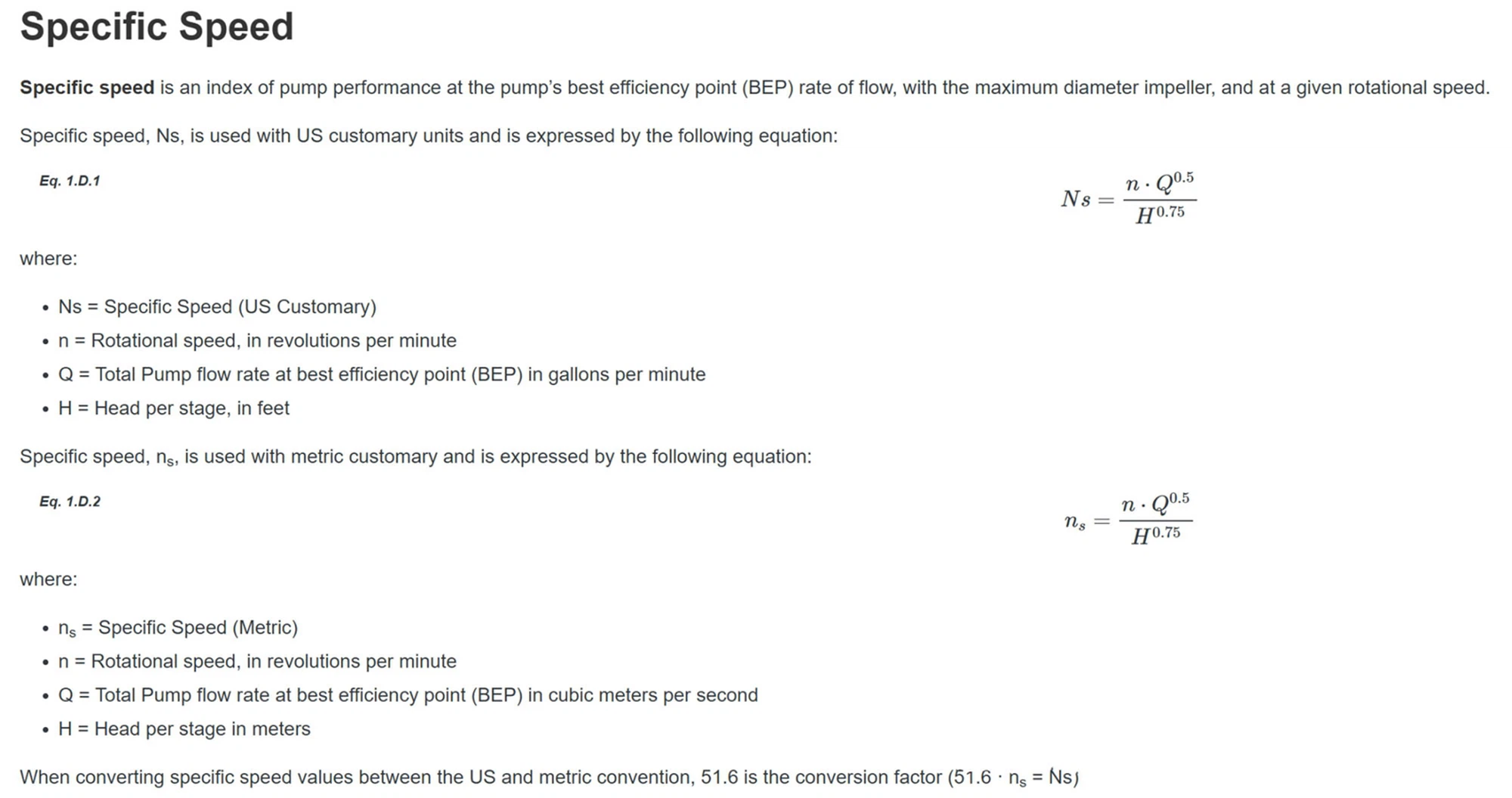
Figure 1: Standard definitions of specific speed formulas Ns (US unit) and ns (metric unit) (Image source: Hydraulic Institute)
The relationship between specific speed and impeller structure is not random, but strictly follows the fundamental laws of fluid dynamics. Low specific speed conditions (high head, low flow rate) require narrow-channel radial impellers; high specific speed conditions (low head, high flow rate) primarily use mixed-flow and axial-flow structures. The figure below visually illustrates the evolution of impeller type with varying specific speed.
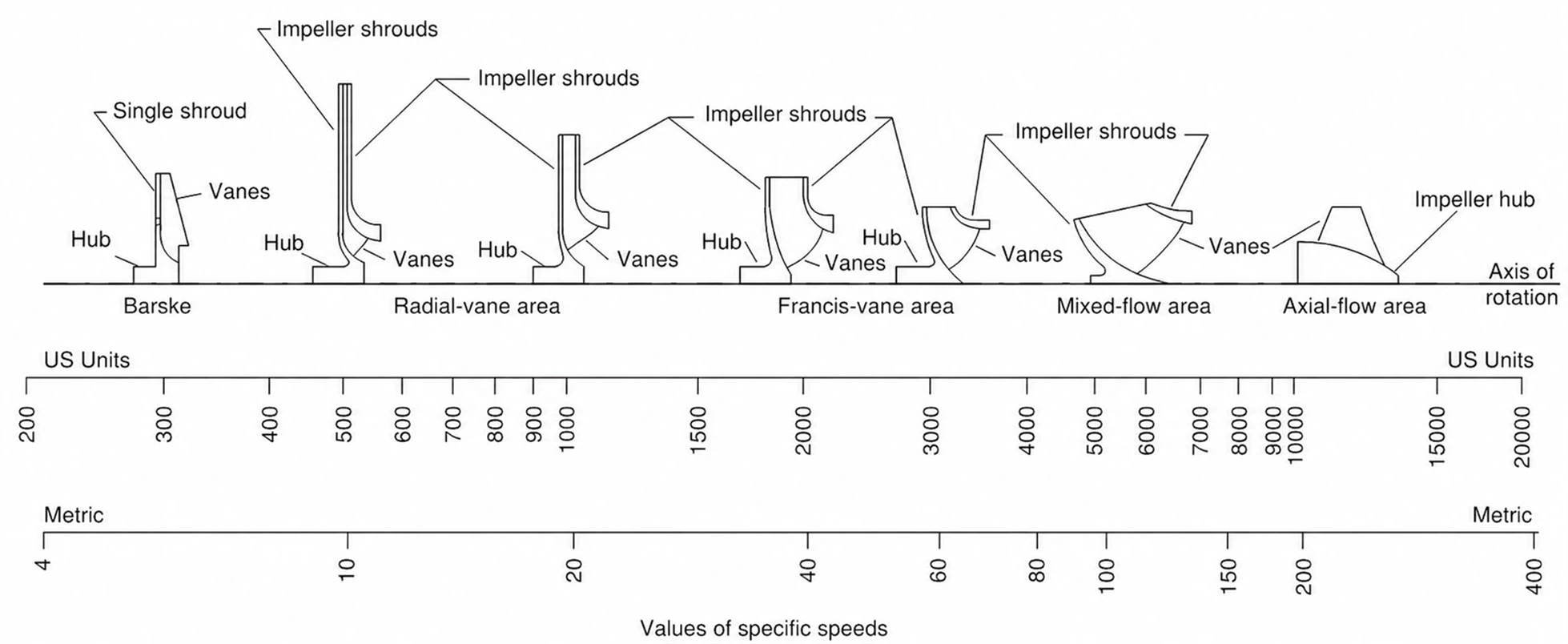
Figure 2: Impeller structure variation with specific speed - at low specific speeds, the impeller exhibits a Barske-type and narrow-channel radial blade structure, while at high specific speeds, it transitions to an axial flow structure.
The peak achievable efficiency of the pump varies significantly across different specific speed ranges.
Pumps operating within their optimal specific speed range (metric Ns approximately 35–60, US Ns approximately 1,800–3,000) achieve the highest efficiency; however, pumps operating at their extreme specific speeds, especially at extremely low specific speeds, naturally have lower efficiency ceilings due to the higher proportion of friction and leakage losses relative to energy transfer.
Pump Structural Dimensions
The second most crucial factor affecting pump efficiency is structural size: larger pumps inherently possess higher efficiency levels.
This follows a square-cubic law. As pump structural dimensions increase, the wetted surface area of the flow-through components that generate frictional losses increases with the square of the linear dimension, while the volumetric flow rate of the medium increases with the cube of the linear dimension. Therefore, as pump size increases, the proportion of various losses relative to effective hydraulic work gradually decreases.
To illustrate this principle visually, consider a pump with a specific speed of 30 metric units and 1500 US units:
A pump with an optimal efficiency flow rate of 36 cubic meters per hour (m³/h, equivalent to 160 US gallons per minute gpm) typically has an efficiency of approximately 80%. Maintaining the same specific speed, increasing the optimal efficiency flow rate to 180 cubic meters per hour (equivalent to 800 gpm) can potentially increase its efficiency to approximately 87%.
The 7% efficiency improvement is entirely due to the size effect, and the hydraulic design requires no changes.
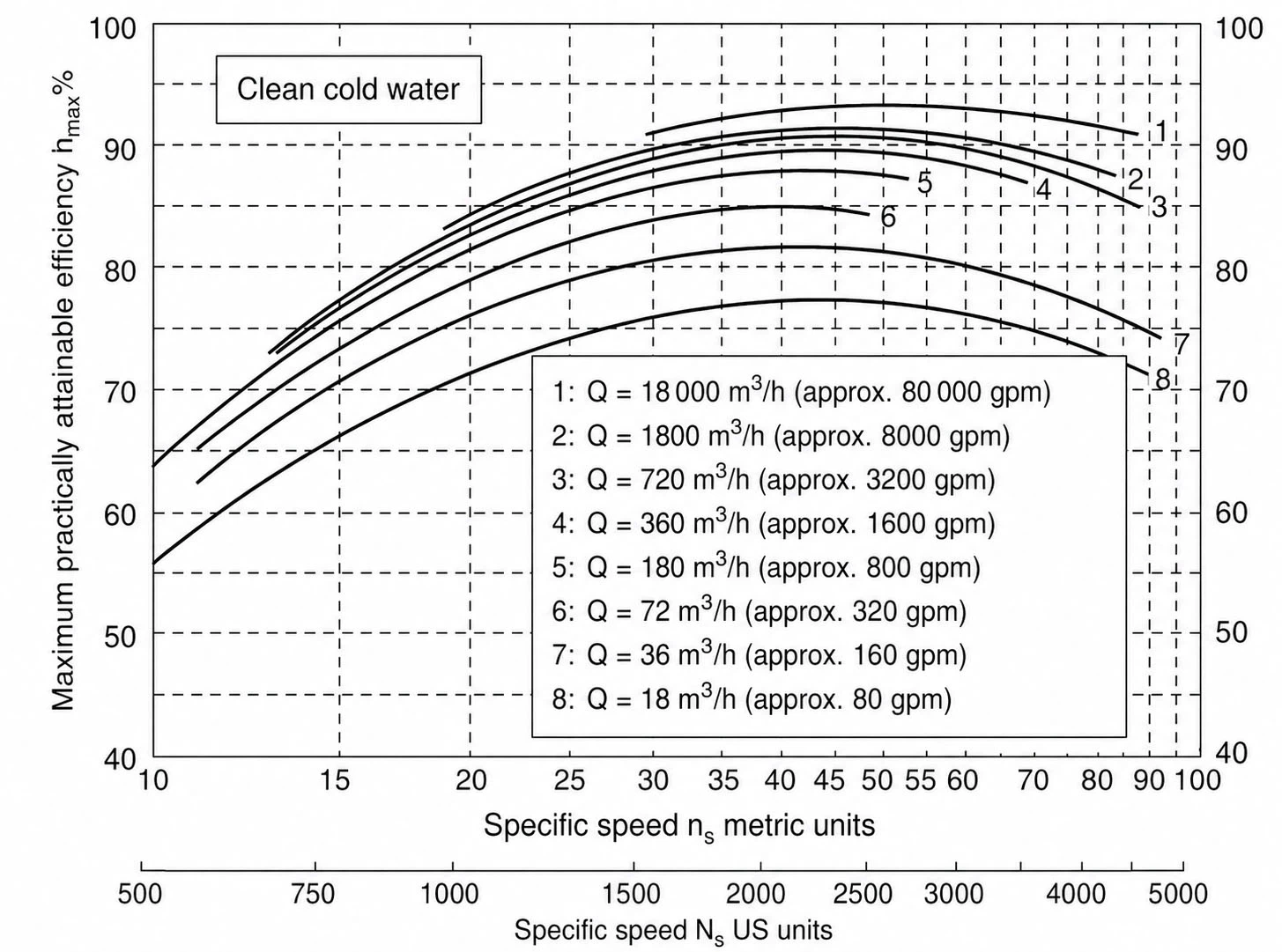
Figure 3: Relationship between the actual maximum achievable pump efficiency and specific speed and pump size under clean cold water conditions
The figure above illustrates both major efficiency influencing factors. Each curve in the figure represents a pump size (characterized by the flow rate at the optimal efficiency point), and the horizontal axis represents specific speed. The efficiency differences under different operating conditions are significant: centrifugal pump efficiency varies greatly; the efficiency of a low-flow, high-head Barske impeller pump can be as low as single digits, while large centrifugal pumps operating within their optimal specific speed range can achieve actual maximum efficiencies of 91% or higher.
-
Technological Approaches for Pump Manufacturers to Improve Efficiency
Specific speed and pump specifications determine the theoretical upper limit of a pump's efficiency. However, the actual efficiency achieved in operation largely depends on the precision of the hydraulic design and manufacturing process. This is the core of the technological differentiation achieved by experienced manufacturers.
Impeller Design Optimization
The hydraulic geometry of the impeller is a crucial factor in determining efficiency. The number of blades, the inlet and outlet angles of the blades, the blade thickness, and the shape of the flow channels between the blades all have a direct and quantifiable impact on hydraulic performance.
The selection of the number of blades requires a comprehensive balance: too few blades result in insufficient fluid guidance, easily leading to backflow and jet-wake phenomena, causing significant turbulent energy loss; conversely, too many blades increase the wetted surface area of the flow path, compressing the flow channel area, causing blockage losses, and thus reducing the medium's flow capacity.
In addition to the number of blades, the curvature and twist of the blade profile directly determine the smoothness of the fluid's accelerated flow within the impeller. An unreasonable flow channel design can create localized flow separation zones, where fluid energy is dissipated in the form of eddies, failing to be effectively converted into head.
With the help of modern CFD simulation tools, manufacturers can iteratively simulate hundreds of geometric schemes, systematically optimize key parameters such as impeller inlet diameter, blade wrap angle, and outlet width, and find the optimal design balance point, enabling the pump to simultaneously achieve optimal hydraulic efficiency, structural strength, and manufacturability.
Manufacturing Accuracy
The impeller's manufacturing process is as important as its hydraulic design. Even with a perfectly optimized geometric model achieved through computer-aided design (CAD), manufacturing deviations can significantly reduce its performance. Traditional sand casting often results in excessive surface roughness, deviations in blade thickness and flow channel dimensions, and porosity defects in some castings. These manufacturing defects all disrupt the ideal flow channel morphology, leading to a decrease in hydraulic efficiency.
Using high-precision manufacturing processes such as investment casting and integral machining of solid forgings can achieve higher geometric dimensional accuracy, smoother flow surfaces, and ensure consistent blade profile height.
This precision advantage is particularly pronounced in low specific speed pumps: these pumps naturally have narrow flow channels, and even a small absolute deviation in the channel width can cause a significant change in the proportion of the flow area; surface roughness also significantly affects the hydraulic diameter ratio. Therefore, in low specific speed pumps, the efficiency difference between sand-cast impellers and precision-machined impellers can reach several percentage points.
Surface Finish and Coating Treatment
For in-service impellers, improving the surface finish of the flow path is a highly cost-effective way to improve efficiency without requiring redesigning the hydraulic system. When fluid flows through the impeller channel, surface roughness directly increases frictional losses along the flow path, significantly impacting pump efficiency.
Fine polishing of the impeller surface can effectively reduce frictional losses and restore some hydraulic efficiency; applying a specialized coating can further amplify the efficiency gains. Modern ceramic-based and polymer-based coatings offer superior hydraulic smoothness compared to polished metal surfaces, while also possessing excellent corrosion and erosion resistance. This means that the efficiency improvement can be maintained long-term and will not rapidly diminish with long-term pump wear. For operators with large pump clusters, implementing surface modification treatments on in-service equipment in batches can achieve substantial cumulative energy savings.
Macro-level Comprehensive Perspective
Pump efficiency is not merely an engineering indicator; it is directly related to equipment energy consumption, operating costs, and carbon footprint. Centrifugal pumps consume a significant amount of electricity in the industrial sector. Therefore, even a small improvement in the efficiency of the entire pump station can create considerable energy and cost savings over the equipment's entire lifecycle.
Ultimately, pump efficiency is not determined by a single factor. Appropriate matching of specific speed, precise selection and dimensional determination based on actual operating conditions, coupled with rigorous hydraulic design, precision manufacturing, and surface treatment processes, are essential to effectively narrowing the gap between theoretical achievable efficiency and actual operational performance.
Whether for new units or existing systems, all industries require close collaboration between equipment manufacturers and operators to implement these design principles.