

High-Temperature Centrifugal Pump Selection: Materials, Seals, Cooling and Thermal Expansion
Nov 11, 2026
Leave a message
High-temperature centrifugal pumps are widely used in chemical processing, petrochemical production, refineries, thermal power plants, and heat-transfer systems. These applications often involve hot water, thermal oil, hot hydrocarbons, and other process fluids that require reliable circulation under demanding operating conditions.
Selecting a centrifugal pump for high-temperature service involves more than choosing a model with sufficient flow and head. Elevated temperatures affect material strength, mechanical seal performance, bearing lubrication, pump clearances, and the thermal expansion of the entire assembly.
A pump that performs reliably at room temperature may experience seal leakage, excessive vibration, bearing overheating, or even rotor seizure when exposed to unsuitable high-temperature conditions.
This guide explains the major factors involved in high-temperature centrifugal pump selection, including material compatibility, mechanical seals, cooling arrangements, thermal expansion, and NPSH requirements.
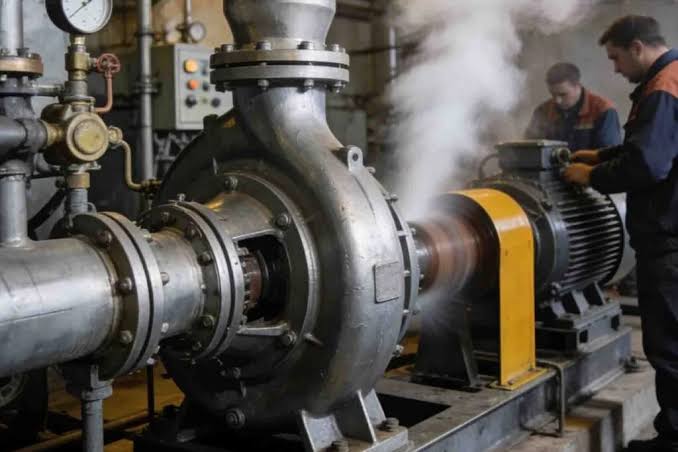
1. What Makes a Centrifugal Pump Suitable for High-Temperature Service?
A high-temperature centrifugal pump is designed to handle elevated liquid temperatures while maintaining acceptable hydraulic performance, mechanical stability, and sealing reliability.
The key difference between a standard pump and a pump designed for demanding thermal conditions is not necessarily one individual component. It is the compatibility of the complete pump system.
Several factors must be considered:
Pump casing and impeller materials must withstand the operating temperature, pressure, and fluid environment.
Mechanical seals must operate within their temperature and pressure limits.
Bearings and lubrication systems must remain within their allowable operating temperatures.
Pump clearances must accommodate thermal expansion.
Cooling and flushing arrangements must maintain suitable conditions around seals and bearings.
The installation must account for thermal growth and alignment changes.
Simply installing a high-temperature mechanical seal in an ordinary pump does not automatically make the entire pump suitable for high-temperature operation. The casing support, shaft configuration, bearings, clearances, and cooling arrangement must also be evaluated.
2. Identify the Actual Operating Temperature and Fluid Conditions
Temperature is one of the most important selection parameters, but it should be evaluated together with flow rate, head, pressure, and liquid properties.
Before selecting a pump, distinguish between three temperature conditions:
Normal operating temperature: The temperature at which the pump operates during typical production.
Maximum continuous temperature: The highest temperature expected during sustained operation.
Abnormal or transient temperature: A temporary temperature that may occur during startup, shutdown, process changes, or equipment malfunction.
Designing only for the normal operating temperature may leave insufficient protection against unexpected operating conditions.
The pumped liquid must also be clearly identified. Water, thermal oil, hydrocarbons, and chemical solutions behave differently when exposed to high temperatures.
Important fluid properties include:
Density and viscosity at operating temperature.
Vapor pressure and boiling characteristics.
Chemical composition and corrosion potential.
Solid particle concentration and abrasive properties.
Thermal stability and oxidation characteristics.
Compatibility with seal faces, elastomers, gaskets, and metallic materials.
For example, thermal oil may degrade or form deposits when exposed to excessive temperatures. Such deposits can restrict internal passages, affect heat transfer, and interfere with seal or bearing operation.
Therefore, temperature alone is not sufficient to determine the pump configuration.
3. How to Select Suitable Materials for High-Temperature Pumps
Material selection directly affects pump strength, corrosion resistance, dimensional stability, and service life.
At elevated temperatures, materials may experience changes in mechanical properties, including reduced strength, increased thermal expansion, and changes in resistance to deformation over time.
The correct selection depends on both temperature and the characteristics of the pumped liquid.
3.1 Pump Casing Materials
The pump casing must withstand operating pressure, temperature variation, and external mechanical loads.
Common material considerations include:
| Material category | Typical considerations |
|---|---|
| Cast iron | Suitable for selected water applications, subject to temperature, pressure, and design limits |
| Carbon steel | Used in many industrial applications where strength and process-fluid compatibility are appropriate |
| Stainless steel 304 / 316 | Considered for applications requiring corrosion resistance, subject to fluid chemistry and temperature |
| Alloy steel | May be suitable for demanding high-temperature and high-pressure service |
| Other specialized alloys | Selected for specific corrosion, erosion, or temperature requirements |
No single material is suitable for every high-temperature application.
For example, stainless steel may provide good corrosion resistance in one process but may not be the most appropriate choice for another fluid or pressure condition. In high-temperature hydrocarbon service, alloy steel may be considered where the project specifications and mechanical design require it.
Material selection should be based on operating temperature, pressure, corrosion rate, mechanical strength, and applicable industry requirements.
3.2 Impeller and Shaft Materials
The impeller and shaft operate under rotational and hydraulic loads while being exposed to the pumped liquid.
Their materials should maintain sufficient strength and dimensional stability at the operating temperature.
The following factors require evaluation:
Shaft strength and allowable stress.
Impeller mechanical strength and rotational speed.
Corrosion and erosion resistance.
Thermal expansion differences between connected components.
Material compatibility at fitted and contact surfaces.
A difference in thermal expansion between the shaft, impeller, sleeve, and casing can change component clearances during operation. This should be considered during pump design and assembly.
4. Mechanical Seal Selection for High-Temperature Pumps
Mechanical seals are among the most temperature-sensitive components in centrifugal pumps.
A mechanical seal consists of contacting faces, secondary sealing elements, springs or bellows, and other components. Each has its own material and operating limits.
When the temperature increases, seal face lubrication, secondary seal elasticity, and the thermal stability of the seal assembly may be affected.
4.1 Conventional Mechanical Seals
Conventional mechanical seals may be suitable for some elevated-temperature applications, provided that their complete material configuration remains within the manufacturer's operating limits.
The secondary sealing elements, such as O-rings or gaskets, require particular attention.
Their temperature resistance and chemical compatibility must be checked against the actual conditions in the seal chamber, which may differ from the bulk liquid temperature.
4.2 Metal Bellows Mechanical Seals
Metal bellows mechanical seals are commonly considered for demanding high-temperature applications.
Unlike some conventional pusher-type designs, metal bellows seals can eliminate certain dynamic secondary elastomer sealing elements. The bellows itself provides the flexibility required to maintain contact between the sealing faces.
Potential advantages include:
Reduced dependence on certain high-temperature-sensitive elastomeric components.
Suitability for selected high-temperature hydrocarbon and process-fluid applications.
Compensation for some axial movement.
Availability in different pressure and speed configurations.
However, metal bellows seals are not suitable for every operating condition. Bellows materials, seal face combinations, pressure limits, rotational speed, and corrosion resistance must all be evaluated.
Static gaskets and other sealing components may still require special high-temperature materials.
4.3 Single and Double Mechanical Seals
A single mechanical seal may be appropriate for applications with manageable leakage risks and suitable operating conditions.
For hazardous, toxic, volatile, or environmentally sensitive fluids, a dual mechanical seal arrangement may be considered.
Depending on the seal arrangement, a pressurized barrier-fluid or unpressurized buffer-fluid system can provide additional protection.
Seal support systems should be designed according to the application and applicable requirements, rather than selected simply because the pumped liquid has a high temperature.
API 682 is a commonly referenced standard for mechanical seal systems in applicable process pump services.
5. Cooling Arrangements: Air Cooling or Water Cooling?
Cooling is an important part of high-temperature pump design because the mechanical seal and bearings may require lower operating temperatures than the pumped liquid.
The purpose of cooling is not necessarily to reduce the temperature of the entire pump. It is to maintain suitable thermal conditions at sensitive locations.
5.1 Air-Cooled Designs
Air cooling uses natural convection, cooling fins, or forced airflow to remove heat from selected pump components.
It can provide a relatively simple arrangement without requiring a separate cooling-water supply.
Certain heat-transfer pumps are designed with a cooling section between the hot pump casing and the shaft seal. This arrangement can reduce heat transfer toward the seal and bearing areas even when the pumped thermal oil operates at a high temperature.
The suitability of air cooling depends on pump construction, ambient temperature, heat generation, operating duration, and the required component temperatures.
5.2 Water-Cooled Designs
Water cooling uses a cooling jacket, heat exchanger, or another circulation arrangement to remove heat from the seal chamber or bearing housing.
It may be beneficial when the thermal load is too high for the designed air-cooling arrangement.
Potential advantages include:
More controlled heat removal.
Better temperature management around selected components.
Suitability for certain continuous-duty applications.
Improved control of seal chamber temperature when correctly designed.
However, cooling-water quality, flow rate, pressure, and temperature must be controlled.
Scaling, corrosion, blocked passages, or interrupted cooling flow can reduce cooling effectiveness and lead to equipment problems.
5.3 How Should the Cooling Method Be Selected?
| Factor | Air cooling | Water cooling |
|---|---|---|
| Cooling medium | Ambient air | Circulating cooling water |
| System complexity | Generally simpler | Requires additional piping and cooling arrangements |
| Cooling capacity | Depends on airflow and heat transfer | Can provide controlled heat removal when properly designed |
| Maintenance | Fan and cooling-surface inspection | Requires monitoring of flow, water quality, and cooling passages |
| Typical application | Suitable designs with manageable heat transfer | Applications requiring additional or more controlled cooling |
There is no universal temperature at which every pump must change from air cooling to water cooling. The correct method depends on the actual temperature distribution and heat load within the pump.
Some high-temperature thermal-oil pumps use air-cooled cooling sections, while other installations require water-cooled seal chambers or bearing housings.
The manufacturer's design data should determine the cooling configuration.
6. Thermal Expansion and Pump Installation
Thermal expansion is one of the most important mechanical considerations in high-temperature pump service.
When a pump heats up, its casing, shaft, baseplate, and connected piping expand. These components may not expand by the same amount or in the same direction.
If thermal growth is not properly accommodated, it can change the alignment between the pump and driver.
Potential consequences include:
Coupling misalignment.
Increased bearing loads.
Shaft deflection.
Mechanical seal face wear.
Excessive vibration.
Abnormal casing or piping stress.
Centerline and Foot-Mounted Support
For selected high-temperature process pumps, centerline-mounted casing arrangements can help manage thermal growth by supporting the casing closer to its horizontal centerline.
This can reduce the extent to which vertical thermal expansion changes the alignment reference.
Foot-mounted arrangements may also be suitable in applications where the casing temperature, geometry, and mounting design allow acceptable thermal movement.
The correct support arrangement should be determined from the pump's mechanical design, temperature range, and installation requirements.
Hot Alignment and Pipe Strain
Pump and driver alignment should consider both cold installation conditions and expected operating temperatures.
The required cold alignment offset should be established according to the manufacturer's instructions and anticipated thermal growth.
Suction and discharge piping should also be properly supported so that external pipe loads do not distort the pump casing.
For high-temperature installations, alignment verification after thermal stabilization may be required as part of commissioning.
7. Why NPSH Becomes More Important at High Temperatures
NPSH is another critical factor in high-temperature pump selection.
As liquid temperature rises, its vapor pressure generally increases. This reduces the pressure margin between the liquid's actual pressure and the pressure at which vapor formation begins.
If local pressure inside the impeller falls below the liquid's vapor pressure, cavitation can occur.
For a pressurized supply tank with negligible surface velocity, NPSH available can be estimated using:
NPSHa = (Pt - Pv) / (rho x g) + Hs - Hf
Where:
Pt = Absolute pressure above the liquid surface.
Pv = Vapor pressure of the liquid at operating temperature.
rho = Liquid density.
g = Gravitational acceleration.
Hs = Liquid surface elevation above the pump's NPSH datum.
Hf = Suction pipeline friction and local losses.
The actual NPSHa should be compared with the pump manufacturer's NPSH requirement at the specified operating flow and speed, allowing for an appropriate engineering margin.
Using room-temperature vapor pressure values for a high-temperature liquid can result in serious selection errors.
For example, hot water and thermal oil have very different physical properties. The NPSH calculation must use the actual liquid data rather than assuming that all pumped liquids behave like water.
8. Startup, Shutdown and Maintenance of High-Temperature Pumps
Even a correctly selected pump can experience premature failure if it is operated incorrectly.
Gradual Preheating
Where required by the pump and process design, the pump casing and associated piping should be gradually brought toward operating temperature before startup.
Uneven heating can create thermal stresses and cause differential expansion between components.
The preheating procedure should follow the manufacturer's instructions and the plant's operating requirements.
Controlled Shutdown
Rapid cooling may also produce thermal stress.
Where the fluid is prone to solidification, crystallization, or increased viscosity at lower temperatures, appropriate heat tracing or heating arrangements may be needed after shutdown.
The correct shutdown procedure depends on the process fluid and installation design.
Regular Inspection
Maintenance personnel should monitor:
Mechanical seal leakage.
Bearing temperatures and lubrication condition.
Cooling-water flow and temperature, where applicable.
Pump vibration and abnormal noise.
Coupling alignment.
Casing, baseplate, and pipeline conditions.
Changes in flow rate, head, and operating temperature.
Early detection of abnormal conditions helps prevent small problems from developing into major equipment failures.
9. What Information Is Needed to Select a High-Temperature Centrifugal Pump?
To obtain an appropriate pump recommendation, engineers should prepare the following operating information:
| Parameter | Information required |
|---|---|
| Liquid type | Water, thermal oil, hydrocarbon, chemical solution, or other fluid |
| Normal temperature | Typical continuous operating temperature |
| Maximum temperature | Highest expected continuous or transient temperature |
| Flow rate | Normal, minimum, and maximum flow |
| Total head | Required pump head under actual system conditions |
| Operating pressure | Suction pressure and discharge pressure |
| Fluid properties | Density, viscosity, vapor pressure, and corrosiveness |
| Suction conditions | Tank pressure, liquid level, pipeline losses, and NPSHa |
| Sealing requirements | Leakage limitations and applicable seal arrangement |
| Cooling requirements | Available cooling medium, temperature, pressure, and flow |
| Standards | Applicable project requirements, including API 610 or API 682 where specified |
For petrochemical and other critical applications, project specifications may require particular design, inspection, testing, and documentation standards.
API 610 is commonly specified for certain petroleum, petrochemical, and natural gas process pump services. API 682 addresses mechanical seal and sealing-system requirements. Their applicability should be confirmed against the project specification rather than assumed for every high-temperature pump.
High-temperature centrifugal pump selection requires a complete evaluation of hydraulic performance, material compatibility, mechanical sealing, cooling arrangements, and thermal expansion.
The most reliable solution is not necessarily the pump with the highest temperature rating or the most complex sealing system. It is the configuration that matches the actual liquid properties, operating temperature, pressure, flow requirements, and installation conditions.
By selecting appropriate materials, designing suitable seal and cooling arrangements, accommodating thermal movement, and verifying NPSH at the actual operating temperature, engineers can reduce leakage, vibration, cavitation, and premature component failure.