

Boiler Feed Water Pump Cavitation: Causes, NPSH Calculation and Prevention
Nov 06, 2026
Leave a message
Boiler feed water pumps play a critical role in industrial boilers and power generation systems. They deliver high-temperature water from the feedwater tank or deaerator into the boiler, overcoming the pressure inside the boiler and the resistance of the feedwater system.
Because boiler feedwater is often close to its saturation temperature, these pumps can face demanding suction conditions. Even a relatively small reduction in suction pressure may cause part of the liquid to vaporize, leading to cavitation, vibration, impeller damage, and unexpected shutdowns.
Understanding Net Positive Suction Head (NPSH) is therefore essential when selecting and operating a boiler feed water pump. However, cavitation prevention involves more than simply choosing a pump with a low NPSH requirement. The deaerator arrangement, suction pipeline design, operating temperature, water level, and minimum flow protection must all be considered.
This article explains the causes of boiler feed pump cavitation, how to calculate NPSH available, and the practical measures that help maintain reliable pump operation.
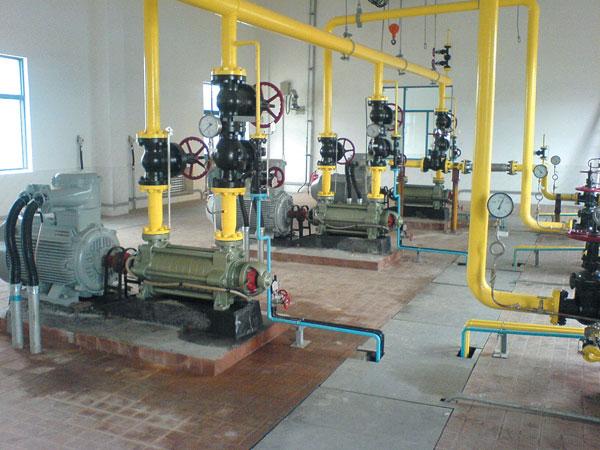
1. What Causes Cavitation in Boiler Feed Water Pumps?
Cavitation occurs when the local pressure of a liquid falls below its vapor pressure at the operating temperature. Vapor bubbles then form and move with the liquid into regions of higher pressure, where they collapse rapidly.
Repeated bubble collapse can generate localized pressure impacts that damage metal surfaces inside the pump. Over time, this may cause impeller pitting, erosion, noise, vibration, and reduced hydraulic performance.
Boiler feed pumps are particularly sensitive to suction conditions because feedwater is frequently maintained at an elevated temperature.
The most common causes include:
1.1 High Feedwater Temperature
As water temperature increases, its saturation vapor pressure also increases. This means the pressure at the pump inlet must remain sufficiently above the water's vapor pressure to prevent vapor formation.
When hot feedwater enters a pump under inadequate suction conditions, the local pressure near the first-stage impeller eye may fall below the vapor pressure. Vapor bubbles can then develop and collapse as the water moves through the impeller.
This is why high-temperature boiler feed systems require careful NPSH evaluation.
1.2 Insufficient Suction Pressure or Static Head
Boiler feed pumps commonly draw water from a feedwater tank or pressurized deaerator.
The pressure above the water surface and the elevation of the liquid level relative to the pump both contribute to the available suction head.
If the deaerator pressure decreases or its water level becomes too low, the suction pressure available to the pump may also decrease.
Locating the feedwater tank or deaerator above the pump can provide additional static suction head, helping improve the inlet pressure conditions.
1.3 Excessive Suction Pipeline Losses
The suction pipeline creates friction losses as water flows toward the pump.
An undersized pipe, excessive bends, restrictive valves, partially blocked strainers, or unsuitable fittings can increase these losses.
At higher flow rates, pipeline losses generally increase, reducing the NPSH available at the pump inlet.
The suction line should therefore be designed to minimize unnecessary resistance while maintaining appropriate flow velocity and installation conditions.
1.4 Operation Outside the Recommended Flow Range
Operating a boiler feed pump at an excessively high flow rate may increase its NPSH requirement and reduce the available suction margin.
At very low flow rates, internal flow recirculation and heat accumulation can also create hydraulic instability and damage the pump.
These problems are especially important during boiler startup, shutdown, and low-load operation, when feedwater demand may change significantly.
2. Understanding NPSHa, NPSHr and NPSH3
NPSH stands for Net Positive Suction Head. It describes the pressure energy available at the pump suction above the vapor pressure of the liquid, expressed as a height of liquid column.
Three terms are particularly important in pump selection.
NPSHa – Net Positive Suction Head Available
NPSHa is determined by the pumping system. It represents the suction head available under actual operating conditions after considering liquid pressure, elevation, vapor pressure, and suction pipeline losses.
NPSHr – Net Positive Suction Head Required
NPSHr is a pump performance characteristic provided by the manufacturer. It represents the minimum NPSH required to meet a specified hydraulic performance criterion at a particular flow rate, speed, and liquid condition.
NPSH3 – Net Positive Suction Head at 3% Head Drop
NPSH3 is the NPSH value at which the measured total head of the first stage of the pump decreases by 3% during a cavitation test.
For multistage pumps, the first-stage head is used as the reference for this criterion.
Importantly, NPSH3 does not indicate the exact point at which cavitation first begins. Cavitation may already be present before the pump reaches the 3% head-drop condition.
This distinction is important when evaluating boiler feed pump reliability. A pump should not be selected simply because the calculated NPSHa is marginally higher than the published NPSH3.
3. How to Calculate NPSH Available for a Boiler Feed Pump
For a pressurized feedwater tank or deaerator, NPSHa can be estimated using the following equation.
NPSHa = (Pt - Pv) / (rho x g) + Hs - Hf
Where:
Pt = Absolute pressure above the liquid surface in the tank (Pa).
Pv = Saturation vapor pressure of the feedwater at its operating temperature (Pa).
rho = Feedwater density at the operating temperature (kg/m³).
g = Gravitational acceleration (approximately 9.81 m/s²).
Hs = Vertical elevation of the liquid surface above the pump's NPSH datum (m).
Hf = Friction and local losses in the suction pipeline (m).
The formula assumes that the liquid surface velocity is negligible, as is normally appropriate for a sufficiently large tank.
If the liquid surface velocity is significant, its velocity head must also be included. The pump's NPSH datum should be identified according to the manufacturer's documentation.
All pressure values in the equation must be absolute pressures, not gauge pressures.
Why Does Temperature Matter So Much?
The pressure difference between the liquid pressure and its vapor pressure is an essential part of NPSHa.
When feedwater temperature increases, vapor pressure rises. If tank pressure, liquid level, and pipeline conditions remain unchanged, the available NPSH may decrease.
This means a suction arrangement that works reliably at one feedwater temperature may become unsuitable when the temperature increases.
Example: Evaluating a Deaerator and Pump Installation
Consider a simplified boiler feed pump installation with the following operating data:
| Parameter | Illustrative value |
|---|---|
| Absolute pressure above deaerator water | 200 kPa |
| Feedwater vapor pressure | 143.4 kPa |
| Feedwater density | 951 kg/m³ |
| Liquid level above pump datum | 4.0 m |
| Suction pipeline losses | 1.0 m |
First, calculate the pressure head above vapor pressure:
Pressure head = (200,000 - 143,400) / (951 x 9.81)
Pressure head = approximately 6.07 m
Then calculate available NPSH:
NPSHa = 6.07 + 4.0 - 1.0
NPSHa = approximately 9.07 m
This is an illustrative calculation, not a general design value. Actual projects must use the correct feedwater properties, pressure readings, tank level, suction losses, and pump datum.
The result should then be compared with the manufacturer's NPSH curve at the required operating flow and speed, together with an appropriate NPSH margin.
4. How Much NPSH Margin Does a Boiler Feed Pump Need?
For reliable operation, the available NPSH must exceed the pump's required NPSH by an appropriate margin.
NPSHa > NPSHr + Required NPSH Margin
There is no single margin suitable for every boiler feed pump. The required value depends on pump design, operating speed, flow range, feedwater conditions, system characteristics, and applicable project standards.
Engineers should consider the most demanding expected conditions, including:
Maximum feedwater temperature.
Minimum deaerator operating pressure.
Minimum allowable water level.
Maximum required pump flow.
Suction pipeline resistance.
Startup, shutdown, and variable-speed conditions.
Changes in operating pressure during plant load variations.
The NPSH margin should be established using applicable engineering guidance and the manufacturer's recommendations.
For high-temperature boiler feed applications, relying only on the rated operating point may be insufficient. NPSHa and NPSHr should be checked across the expected operating range.
5. Practical Ways to Prevent Cavitation in Boiler Feed Pumps
5.1 Optimize the Deaerator and Feedwater Tank Arrangement
The deaerator is an important part of the boiler feedwater system.
Maintaining an appropriate operating pressure and water level helps provide sufficient suction head to the feed pump.
Where installation conditions permit, locating the deaerator above the pump can increase static suction head and improve NPSHa.
The minimum operating water level should be included in the pump suction calculation rather than relying only on the normal operating level.
5.2 Reduce Suction Pipeline Resistance
Use appropriately sized suction piping to minimize friction losses.
Keep the suction pipeline as direct as practical, avoid unnecessary elbows and restrictive fittings, and ensure that isolation valves are fully open during normal operation.
Strainers and filters should be inspected regularly to prevent blockage.
The suction line should also be arranged to avoid air or vapor pockets and should comply with the pump manufacturer's installation requirements.
5.3 Select a Pump with Suitable NPSH Performance
When selecting a high-pressure boiler feed pump, engineers should evaluate the first-stage impeller and the pump's NPSH curve.
A suitable pump should provide the required flow and head while maintaining an adequate NPSH margin under the actual suction conditions.
For demanding applications, the pump configuration, rotational speed, hydraulic design, and operating range should all be assessed together.
A low NPSH3 value alone does not guarantee that the pump will operate reliably under every condition.
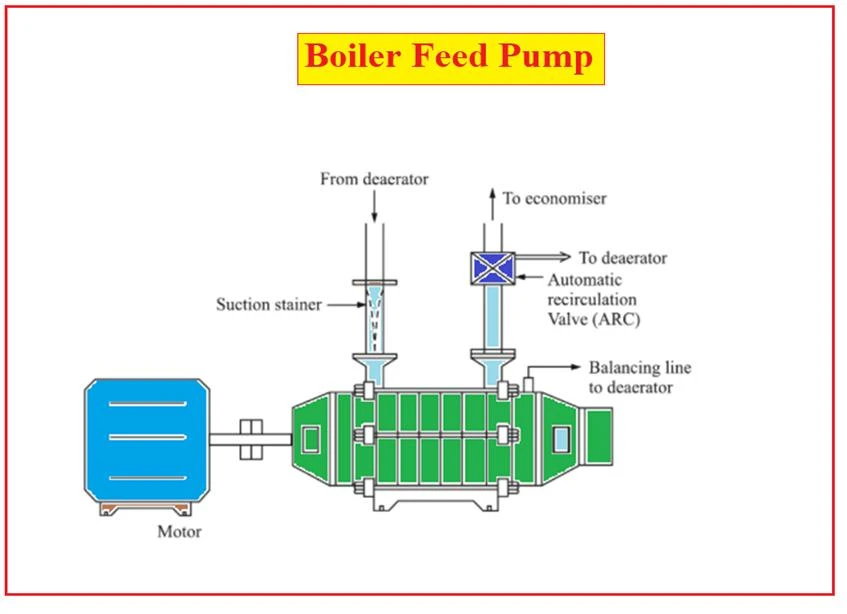
5.4 Install an Appropriate Minimum Flow Recirculation System
Boiler feed pumps must not operate continuously below their specified minimum flow.
At very low flow rates, the liquid remaining inside the pump can absorb energy from the rotating components. This may cause excessive temperature rise, internal recirculation, and localized vapor formation.
A minimum-flow recirculation line can return part of the pump discharge to the deaerator or feedwater tank, maintaining the minimum flow required by the pump.
The system may use an automatic recirculation valve, a controlled bypass valve, or another manufacturer-approved arrangement.
For high-pressure boiler feed systems, the recirculation valve must be designed for the actual pressure drop and temperature conditions. Severe pressure reduction can cause cavitation and erosion inside the control valve itself.
The recirculation flow rate and control logic should therefore be determined according to the pump manufacturer's minimum-flow requirements and the system design.
5.5 Monitor Operating Conditions
Continuous monitoring helps identify problems before serious damage occurs.
Important parameters include:
Suction pressure and deaerator operating pressure.
Feedwater temperature and tank water level.
Pump flow rate and discharge pressure.
Bearing temperature and vibration.
Abnormal noise and changes in pump performance.
Minimum-flow recirculation valve operation.
If cavitation is suspected, check actual suction conditions and compare them with the design data before deciding whether the problem is caused by insufficient NPSHa, an unsuitable operating point, or another mechanical or hydraulic fault.
6. What Should Engineers Consider When Selecting a Boiler Feed Water Pump?
A boiler feed pump must meet both the hydraulic requirements of the boiler and the operating conditions of the feedwater system.
Before selecting a pump, prepare the following information:
| Selection parameter | Required information |
|---|---|
| Flow rate | Normal, minimum, maximum, and design flow |
| Pump head | Required total head and boiler operating pressure |
| Feedwater temperature | Normal and maximum operating temperature |
| Suction pressure | Deaerator or feedwater tank absolute pressure |
| Water level | Minimum, normal, and maximum tank levels |
| NPSH | Available NPSHa and manufacturer's NPSHr curve |
| Operating conditions | Continuous operation, startup, shutdown, and load variation |
| Installation | Pump elevation, suction pipe size, length, and fittings |
| Driver | Motor or engine power and operating speed |
Horizontal multistage centrifugal pumps are widely used in industrial boiler feed applications because multiple impellers can generate the high head needed to deliver feedwater into pressurized boiler systems.
The final pump selection should consider efficiency, material compatibility, sealing arrangement, bearing design, operating range, and maintenance requirements in addition to flow and head.
Cavitation in boiler feed water pumps is closely related to feedwater temperature, suction pressure, liquid level, and pipeline resistance. Because hot feedwater has relatively high vapor pressure, even a small reduction in inlet pressure can significantly affect the available NPSH.
Preventing cavitation requires more than selecting a pump with a low NPSH requirement. Engineers must calculate NPSHa accurately, maintain an appropriate NPSH margin, optimize the deaerator and suction pipeline arrangement, and provide adequate minimum-flow protection.
By combining correct pump selection, suitable system design, and continuous monitoring, industrial facilities can reduce cavitation damage, improve boiler feed pump reliability, and maintain stable boiler operation.