

Centrifugal Pump Dry Running: Causes, Risks, and Remedial Measures
Sep 21, 2026
Leave a message
Centrifugal pumps are designed to operate with liquid inside the pump chamber. The pumped medium not only provides hydraulic energy transfer but also plays an important role in cooling, lubrication, and maintaining stable operation of internal components.
Dry running occurs when a centrifugal pump operates without sufficient liquid inside the pump chamber. This may happen when the pump loses suction supply, runs without proper priming, or operates under insufficient flow conditions.
Although dry running may appear to be a simple operating issue, it can cause serious damage to critical pump components within a short period, especially mechanical seals, bearings, shafts, and wear components.
Understanding the causes and prevention methods of dry running is essential for improving pump reliability and reducing unexpected downtime.
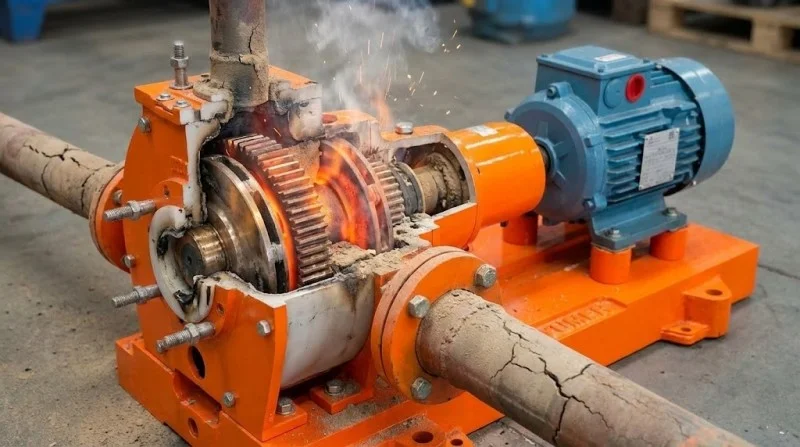
1. What Is Dry Running in a Centrifugal Pump?
Under normal operating conditions, liquid completely fills the internal flow passages of a centrifugal pump.
The pumped fluid performs several important functions:
- Cooling mechanical seals and rotating components
- Providing lubrication for wear surfaces
- Reducing friction between moving parts
- Maintaining hydraulic balance
- Stabilizing internal clearances
When the liquid supply is interrupted, air replaces the liquid inside the pump chamber. The rotating components continue operating without sufficient cooling and lubrication.
As a result, friction heat increases rapidly, internal components may overheat, and the pump can suffer permanent damage.
Dry running should not be confused with normal startup conditions of specially designed self-priming pumps or pumps with specific dry-running capabilities. For conventional centrifugal pumps, continuous dry operation is generally not permitted.
2. Why Is Dry Running Dangerous for Centrifugal Pumps?
2.1 Mechanical Seal Failure
The mechanical seal is usually the first component affected by dry running.
During normal operation, a thin liquid film exists between the seal faces. This film provides lubrication and removes heat generated by friction.
When the pump runs dry:
Seal faces lose lubrication
Friction temperature rises rapidly
Seal rings may crack, deform, or wear
Leakage may occur after restart
In many cases, replacing the mechanical seal alone does not solve the problem if the root cause of dry running is not corrected.
2.2 Bearing and Shaft Damage
Many centrifugal pump components rely on the pumped liquid or lubrication system to maintain stable operating conditions.
Dry running can cause:
Excessive friction
Abnormal vibration
Bearing overheating
Shaft sleeve wear
Rotor instability
For high-pressure multistage pumps, abnormal rotor movement caused by insufficient lubrication can also affect balancing components and increase mechanical stress.
2.3 Overheating and Thermal Damage
Without liquid circulation, heat generated inside the pump cannot be effectively removed.
This may result in:
Local overheating
Deformation of components
Damage to polymer or elastomer parts
Reduced clearance between rotating components
In severe cases, overheating may lead to seizure between rotating and stationary parts.
2.4 Reduced Hydraulic Performance
When air replaces liquid inside the pump chamber:
The impeller cannot transfer energy effectively
Flow and pressure decrease
Pump operation becomes unstable
Noise and vibration may increase
The pump may appear to be running normally, but it is no longer performing its intended function.
3. Common Causes of Centrifugal Pump Dry Running
Dry running is usually caused by system conditions, installation problems, or improper operation rather than the pump itself.
3.1 Insufficient Liquid Supply
The most common cause is insufficient liquid available at the pump suction.
Examples include:
Low tank or reservoir level
Empty suction source
Incorrect suction pipe arrangement
Excessive suction demand
When the liquid level drops below the required condition, air enters the suction line and the pump loses prime.
3.2 Improper Priming Before Startup
Most conventional centrifugal pumps cannot remove air from the casing by themselves.
Before startup, the pump casing and suction line must be properly filled with liquid.
Failure to prime the pump can result in:
No liquid delivery
Air operation
Mechanical seal damage
Unstable performance
3.3 Blocked or Restricted Suction Pipeline
A restricted suction system may prevent enough liquid from reaching the pump.
Possible causes include:
Blocked filters
Closed suction valves
Foreign materials in pipelines
Excessive suction losses
Insufficient suction flow can create conditions similar to dry running.
3.4 Air Leakage in Suction System
Small leaks on the suction side may allow air to enter the pump.
Common locations include:
Pipe connections
Flanges
Valve packing areas
Mechanical joints
Air entering the pump reduces hydraulic stability and may interrupt liquid circulation.
3.5 Improper Pump Selection or Operating Conditions
Operating a pump outside its designed range can increase the risk of unstable suction conditions.
Factors include:
Incorrect pump size selection
Insufficient NPSH available
Excessive suction velocity
Operation far from the best efficiency point
A properly selected pump should match the actual flow, head, fluid properties, and installation conditions.
4. Difference Between Dry Running, Cavitation and Deadheading
These three problems are sometimes confused, but they have different causes.
Dry Running
The pump chamber lacks sufficient liquid.
Main problem:
No lubrication and cooling → overheating and mechanical damage
Cavitation
Liquid exists inside the pump, but local pressure drops below vapor pressure and vapor bubbles form.
Typical results:
Impeller surface damage
Noise
Vibration
Reduced performance
Deadheading
The pump is running with liquid inside but the discharge flow is blocked.
The liquid remains trapped inside the casing, causing:
Temperature increase
Hydraulic instability
Possible pump damage
Correct diagnosis is important because each condition requires different solutions.
5. How to Prevent Centrifugal Pump Dry Running
5.1 Correct Startup Procedures
Before starting:
Confirm sufficient liquid level
Open suction valve completely
Fill and vent the pump if required
Check that pipelines are unobstructed
Never start a conventional centrifugal pump without confirming liquid availability.
5.2 Install Protection Devices
For critical applications, additional protection systems can be used:
Low liquid level switches
Flow monitoring devices
Pressure sensors
Motor current monitoring
Automatic shutdown protection
These systems can stop the pump when abnormal operating conditions are detected.
5.3 Maintain Proper Suction Conditions
A reliable suction system should include:
Correct pipe sizing
Proper pipe support
Minimum air leakage risk
Adequate NPSH margin
Suitable liquid level conditions
The suction system design has a direct impact on pump reliability.
5.4 Regular Inspection and Maintenance
Routine monitoring should include:
Flow rate
Discharge pressure
Vibration
Bearing temperature
Mechanical seal condition
Abnormal noise
Early detection of abnormal conditions can prevent major failures.
Dry running is one of the most common and preventable causes of centrifugal pump failure.
Although the motor may continue running, the absence of liquid inside the pump can quickly damage mechanical seals, bearings, shafts, and other precision components.
The key to preventing dry running is not only repairing damaged parts but identifying the root cause:
Is the liquid supply sufficient?
Is the pump properly primed?
Is the suction system correctly designed?
Are protection devices installed?
With proper selection, installation, operation, and monitoring, centrifugal pumps can achieve stable performance and a much longer service life.