

Analysis of the causes and repair methods of centrifugal pump shaft bending
Jun 12, 2026
Leave a message
Centrifugal pumps are widely used in petrochemical, power, water treatment, and mine drainage industries. The pump shaft, as the core rotating component of a centrifugal pump, is crucial for ensuring stable and efficient operation. However, pump shafts are prone to bending and deformation during service due to various factors, leading to increased vibration, premature wear of bearings and seals, and even serious failures such as shaft breakage. Therefore, when the pump shaft bending exceeds the allowable range, it must be straightened promptly.
This article briefly introduces the main causes of centrifugal pump shaft bending, methods for bending detection and evaluation, and the technical principles and operational points of various straightening processes, providing a reference for pump equipment maintenance.
Causes of centrifugal pump shaft bending
The causes of pump shaft bending are varied, mainly including the following:
Improper operating conditions:
When a centrifugal pump operates for an extended period in a region deviating from its optimal efficiency point, the impeller experiences unbalanced radial forces, causing periodic shaft deflection. Repeated actions can lead to plastic bending deformation. Furthermore, improper start-up and shutdown procedures (such as insufficient intervals between consecutive start-ups and shutdowns to allow for uniform temperature distribution) can easily lead to thermal stress accumulation and cause plastic bending.
Installation and Alignment Issues
Insufficient alignment accuracy of the coupling between the drive unit and the pump can generate additional bending moments on the shaft. When there is angular misalignment of the shaft, bending will occur, manifesting as high-intensity radial vibration. Long-term misaligned operation will accelerate shaft fatigue damage and may even induce bending.
External impact and overload
If the pump encounters a sudden impact during operation (such as a foreign object getting stuck in the impeller), or if the impeller's dynamic balance is disrupted due to solid particles in the medium, the bearing may be subjected to torque exceeding the design value, causing it to bend.
Thermal stress and residual stress
When high-temperature medium pumps are frequently started and stopped or experience drastic changes in operating conditions, the internal thermal stress distribution of the shaft becomes uneven. Residual internal stresses from the manufacturing process are gradually released during service, which may also lead to gradual bending and deformation of the shaft.
Methods for detecting pump shaft bending
Before straightening, the bending condition of the pump shaft must be accurately measured. Runout is the core technical indicator for assessing the degree of shaft bending.
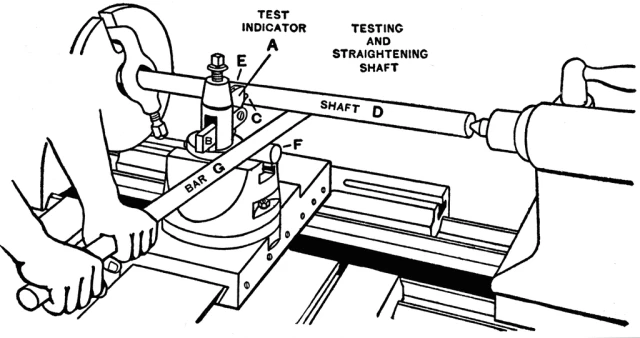
Measurement Tools and Setup. Support both ends of the pump shaft on V-blocks to ensure free rotation. Set up dial indicators (or micrometer indicators) at key locations such as the journal, middle of the shaft, and coupling end, ensuring the probes are perpendicular to the shaft surface.
Measurement Method. Slowly rotate the pump shaft one revolution, recording the maximum and minimum readings of the dial indicator. The difference between these two readings is the radial runout of that section. Based on the measurement results, the location, direction, and amount of bending at the point of maximum bending can be determined.
Permissible tolerance standards. According to industry technical specifications such as "Centrifugal Pump Overhaul" and API 610 standard, the technical requirements for pump shaft straightening are as follows: 1) The taper and ellipticity of the journal should not exceed 1/2000 of the shaft diameter, and the maximum should not exceed 0.05 mm; 2) The journal surface should be free of defects such as pitting and grooves, and the maximum permissible surface roughness Ra is 0.8 μm. The roundness and cylindricity errors of the journal should be less than 0.02 mm; 3) The straightness of the centrifugal oil pump shaft should not exceed 0.05 mm over its entire length; 4) In API 610 standard, the total runout of the low-speed pump shaft should not exceed 0.025 mm, and for high-speed pumps, it should not exceed 0.02 mm. When the measured runout exceeds the above permissible values, straightening treatment is required.
In addition, before straightening, non-destructive testing such as magnetic particle testing (according to JB/T 6912 standard) should be performed on the area with the greatest bending to confirm the presence of surface or near-surface defects such as cracks. If cracks are present, they should be treated before straightening can be carried out; otherwise, the cracks may further expand during the straightening process.
Methods for correcting pump shaft bending
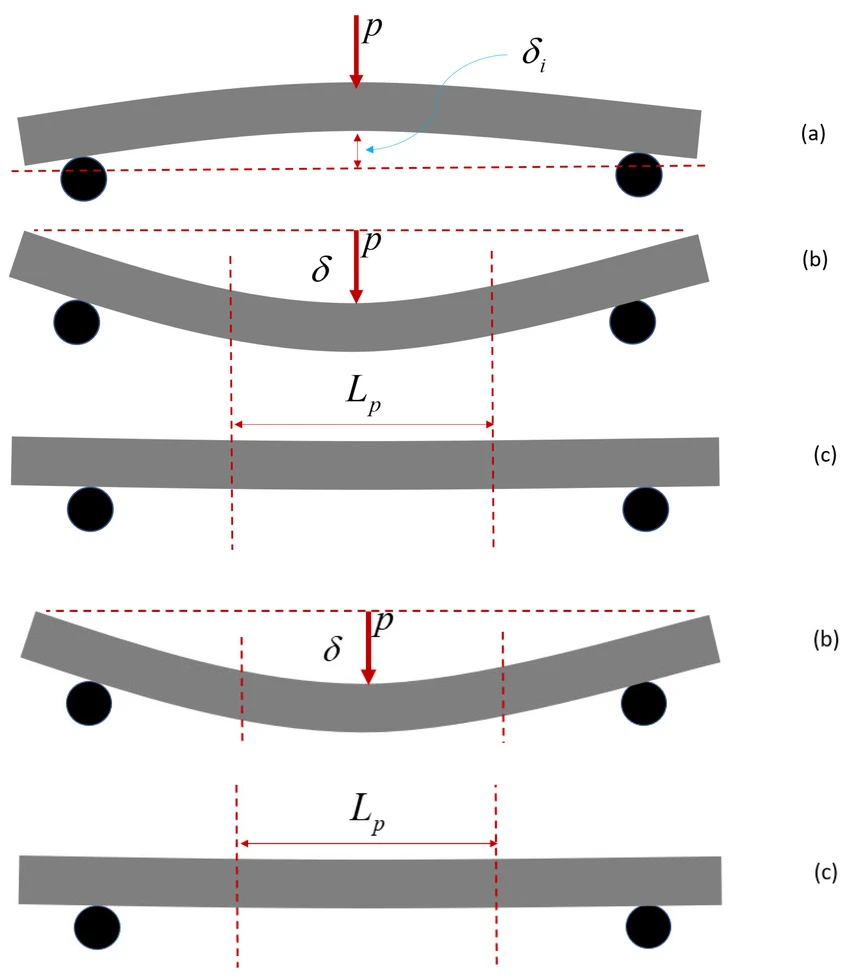
Based on the material properties, diameter, degree of bending, and operating requirements of the pump shaft, straightening methods are mainly divided into three categories: cold straightening, hot straightening, and composite straightening. In addition, there are processes such as twisting straightening, which are suitable for specific scenarios. Cold straightening is suitable for cases with small bending amounts, mainly correcting the straightness of the shaft at room temperature through mechanical pressure. Hot straightening uses localized heating to induce controlled plastic deformation in the metal, and is suitable for shafts with large bending amounts or high-hardness materials. Composite straightening combines heating and pressure, and is suitable for applications with moderate bending amounts and high precision requirements.
Cold straightening method
The cold straightening method refers to the method of applying mechanical external force to straighten a bent pump shaft at room temperature. It is mainly suitable for working conditions where the shaft length is short and the bending amount is small.
Hot Straightening
Hot straightening utilizes the principle of increased plasticity and stress relaxation in metallic materials under heating conditions to straighten bent pump shafts. It is primarily suitable for shafts that are long, have a large degree of bending, or are made of hard materials (hardness not less than 35 HRC) such as carbon steel, alloy steel, and stainless steel.
Twisting and straightening method
Twisting and straightening method is a cold working method that uses local impact to extend the metal surface to achieve straightening. It is suitable for situations with large shaft diameter and small bending amount, and has certain advantages, especially in on-site emergency repair operations.
Technical Principle: The bent concave surface of the shaft is struck with a hammer and a tweezers (usually made of steel with a curved working end matching the shaft surface). This causes the surface metal to plastically stretch under the impact, gradually eliminating the bend.
Operating Points: Place the shaft on hardwood or a square iron plate padded with sheet metal, concave side down. Use the hardwood as support at the apex of the most bent convex surface, and apply downward pressure at both ends with clamps. Within one-third of the shaft's circumference, begin striking from the point of greatest bend (lowest concave surface), gradually expanding outwards. The striking density in the central area should be greater than on the sides. The straightening amount is usually proportional to the number of strikes. After each round of striking, measure the change in bend with a dial indicator until the requirements are met. Finally, perform a low-temperature tempering treatment at 300–400℃ to eliminate work hardening and residual stress.
Precautions: The tweezers should be made of a material with a lower hardness than the pump shaft, or have copper sleeves inlaid on a hard material. The edges of the tweezers must have rounded corners to prevent damage to the shaft surface. The support should be softer than the twisting rod, and the contact area with the shaft should be large enough.
Quality acceptance and non-destructive testing
After straightening, a comprehensive quality inspection of the pump shaft must be conducted to ensure that the straightening quality meets operational requirements. First, runout is checked and measured using a dial indicator at key sections such as the journal, shaft center, and coupling end to confirm that all indicators meet standard requirements. Second, non-destructive testing is performed, using magnetic particle testing on the ferromagnetic material pump shaft according to JB/T 6912 standard to check for new microcracks or surface defects after straightening. If necessary, hardness testing is conducted to confirm that heat treatment (such as low-temperature annealing after localized heating and straightening) has adequately eliminated internal stress and that the shaft material properties have not undergone harmful changes. Only after passing the final inspection can the shaft be reassembled and used.
Straightening the centrifugal pump shaft is a highly technical and specialized maintenance operation. In practice, the degree and location of bending should first be determined through precise measurement. A comprehensive assessment of the shaft's material, diameter, length, amount of bending, and crack condition should be conducted. The technical process should follow "non-destructive testing first, then straightening, and finally acceptance," and either cold or hot straightening methods should be appropriately selected. Regardless of the method used, operating parameters must be strictly controlled, and quality inspections must be performed to ensure that the straightened pump shaft restores its original performance and guarantees the long-term safe and stable operation of the centrifugal pump.